
Heather Elson: Art and Innovation Redefining Waste
ATLANTA, GA —
The Rebirth of Plastic: How Art and Innovation Are Redefining Waste in the Anthropocene
In a world increasingly defined by the overwhelming scale of the climate crisis, two visionaries in Georgia are proving that the solution to plastic pollution might not just be found in a bin, but in a gallery. What began in 2021 as a modest community effort to collect plastic bottle caps has evolved into a sophisticated movement that blends high-tech material science with large-scale public art, challenging our “psychic numbing” toward environmental degradation.
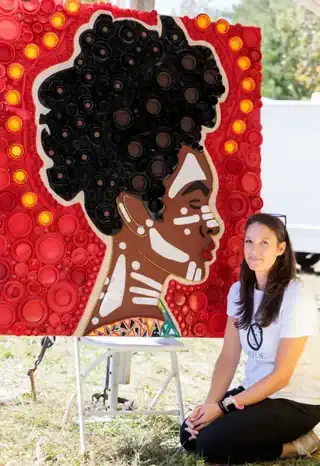
Photo: ©Ben Rose – Heather Elson with Afro-Chique.
The partnership between Heather Elson, founder of the nonprofit No More Liddering, and Alfredo Faubel, the innovator behind Miura Board®, represents a strategic alliance that transforms single-use waste into what they call “cognitive infrastructure”. By 2025, this collaboration has successfully diverted over 75,000 plastic caps and integrated them into 44 distinct art installations across the region, including permanent displays at some of the world’s most prestigious venues.
Washing Away Apathy: The Evolution of a Movement
Heather Elson’s journey into environmental activism was born from her background as a professional counselor for children and families. She recognized that statistics alone—such as the 8 million tons of plastic entering our oceans annually—often lead to a state of emotional paralysis. To combat this, she turned to the tactile, communal experience of art.
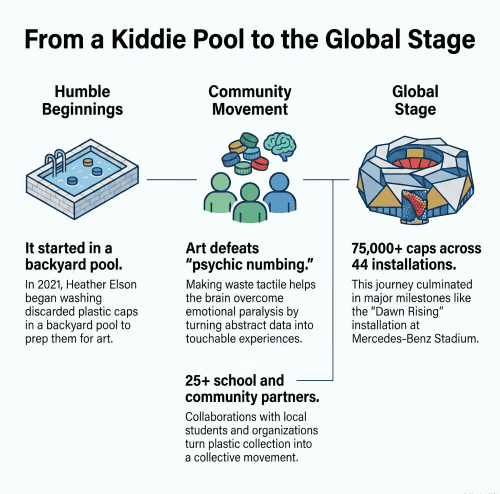
The scale of the operation is a testament to the power of grassroots mobilization. Elson’s methodology is intensely personal: she collects materials ranging from water bottle caps and sour cream containers to medical waste like hospital vial caps. Under the Georgia sun, Elson can often be found washing these thousands of discarded items in a kiddie pool, preparing them to be reborn as vibrant mosaics.
This process is not a solitary one. Elson has forged alliances with over 25 community and school partners, including Davis Elementary, Mabry Middle School, and Wheeler High School. By involving students in the creation of these works, the project fosters a sense of collective responsibility and empathy, turning abstract environmental concerns into concrete, touchable experiences.
The Physical Structure: Miura Board®
While Elson provides the artistic vision, Alfredo Faubel provides the physical foundation. Faubel’s company, Miura Board®, produces a revolutionary material that serves as a 100% recycled alternative to traditional marine plywood. This material is the “backbone” that allows Elson’s art to withstand the elements and remain permanent fixtures in public spaces.
The technical specifications of Miura Board® are as impressive as its ecological credentials. The boards are created through a process of melting and extruding “difficult-to-recycle” plastics mixed with agricultural waste or carpet fibers. The result is a dense, structural board that is completely resistant to moisture, rot, fungi, and splintering.

For Faubel, providing this material is about more than just waste management; it is a philosophical commitment to community building. He maintains that fostering art is essential to the human experience and a critical component of a sustainable society. By using Miura Board® as the canvas, these installations ensure that the waste they utilize is locked away in a durable form, preventing it from ever reaching a landfill or incinerator.
“Dawn Rising”: A Milestone at Mercedes-Benz Stadium
The pinnacle of this collaboration is arguably “Dawn Rising: A New Era of Sustainability,” a massive installation housed at Atlanta’s Mercedes-Benz Stadium. The venue itself is a leader in green infrastructure, being the first stadium in the world to achieve TRUE Platinum zero-waste certification—a feat that requires diverting at least 90% of waste from landfills.
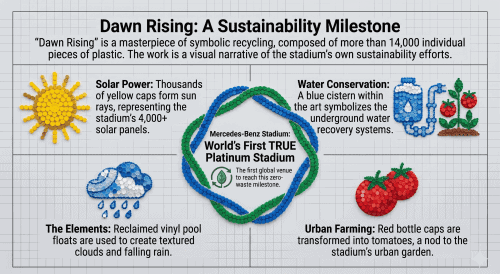
“Dawn Rising” is a masterpiece of symbolic recycling, composed of more than 14,000 individual pieces of plastic. The work is a visual narrative of the stadium’s own sustainability efforts:
- Solar Power: Thousands of yellow caps form sun rays, representing the stadium’s 4,000+ solar panels.
- Water Conservation: A blue cistern within the art symbolizes the underground water recovery systems.
- Urban Farming: Red bottle caps are transformed into tomatoes, a nod to the stadium’s urban garden.
- The Elements: Reclaimed vinyl pool floats are used to create textured clouds and falling rain.
The Student Plastic Mosaic at the Atlanta Botanical Garden
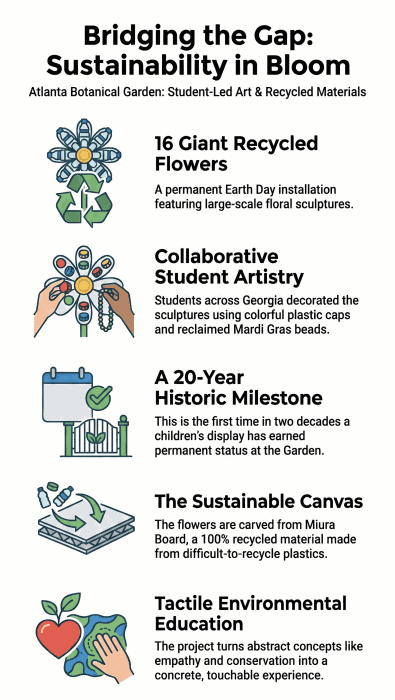
The impact of the Elson-Faubel partnership extends into the realm of youth education through a permanent installation at the Atlanta Botanical Garden. Created for Earth Day, the display features 16 giant flowers carved directly from Miura Board® panels.
These flowers were decorated by students from across Georgia using a eclectic mix of colorful caps and Mardi Gras beads. According to Kathryn Masuda, the garden’s director of youth programs, this marks the first time in 20 years that an installation created by children has been granted permanent status on the grounds. It is a powerful validation of the students’ work and a reminder that the next generation is already equipped to lead the charge in environmental innovation.
The Philosophy of the “Four Pillars”
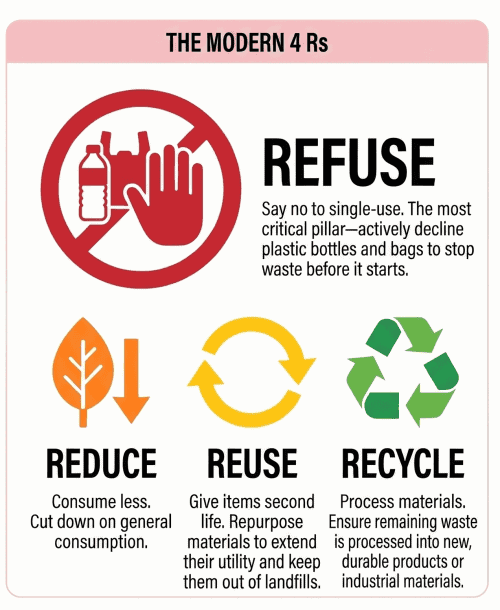
Beyond the physical beauty of the installations, the project advocates for a profound shift in how we perceive waste in the era of the Anthropocene. Elson and Faubel argue that the traditional “Three Rs” (Reduce, Reuse, Recycle) are no longer sufficient to address the scale of modern plastic production.
- Reduce:Cutting down on general consumption.
- Reuse:Giving materials a second life (as seen in the use of Miura Board® and bottle caps).
- Recycle:Processing materials into new products.
- Refuse:The most critical addition. The public is urged to actively refuse single-use plastic bottles and bags whenever possible.
This philosophical framework is what Elson calls “cognitive infrastructure”. By making the scale of our consumption visible and tactile, the art helps the human brain overcome the “psychic numbing” that often occurs when faced with global crises. When an observer sees 14,000 caps in a single mural, they are no longer looking at a statistic; they are looking at their own footprint, reorganized into a form that inspires hope rather than despair.
Conclusion: Waste as Raw Material
The work of No More Liddering and Miura Board® suggests that the end of a product’s life should not be an end at all, but a transformation. By treating plastic waste as a valuable raw material rather than a nuisance, Elson and Faubel are building a bridge between industrial innovation and community empathy.
As “Dawn Rising” shines under the lights of Mercedes-Benz Stadium and the recycled flowers bloom in the Botanical Garden, the message is clear: the rebirth of plastic is not just about cleaning up the planet—it is about cleaning up our perspective. In the fight against climate change, art is not a luxury; it is the infrastructure of our collective imagination, providing the emotional and educational tools we need to build a truly sustainable future.
Sources & Further Reading
- This Atlanta Artist Turns Plastic Lids into Dazzling Public Art — Garden & Gun
- Transforming Trash into Treasure: The Artistic Mission of No More Liddering — Tech Square ATL